Posted by: Pam B. Newberry | December 15, 2011

So What Have We Learned?


Well, we learned….

Everything, but still not enough!

Yep, that just about sums it up…we learned so much, yet we feel as though we know nothing…kinda like being a parent the first time.

These first six months of honey bee keeping have been one of mixed emotions, frustrations, and pure joy.

The initial days of starting out and tending to the bees were not so bad. We took the plunge and began to put into practice all the things we learned from reading and hearing advice of fellow beekeepers.

After we gave the bees an initial sugar syrup feed to help them begin to adjust and to reduce the shock of the move to their new hives, it seemed that within hours the bees had devoured the sweet juice and were happily on their way to living at Hobbit’s Bend.

Hobbit King and I wondered if we should feed them more as we weren’t certain just how much they should receive. Everyone we talked with shared we were fine and advised us to wait and feed them in a couple of days. That was so hard to do. As a parent you always want your children to eat and be healthy. For us to not feed the bees almost seemed as though we were being bad parents. We had to remind ourselves that the point of feeding them is to encourage the bees to begin foraging and learning about their new surroundings. One of the biggest problems for us was timing — due to it being the end of May, there was not enough good foraging plants in bloom when we received the bees to make it easy for them to bring back pollen and nectar.

I worried the bees would starve before they even had a chance. Hobbit King reminded me that the bee hives had four frames of food and brood. He assured me that the bees would be fine and we were doing all that we could do. Yeah, I’m that type of parent. Some would say a “worry wart.” I reluctantly relaxed and decided to wait and see.

The full frame of capped honey (See Picture 1) was shown to us this past February during a honey bee class. It shows what we needed to see in our hives by the end of the summer or as early in the summer as possible. The more capped honey, the more stores, and the more likely the bees will make it through the winter.
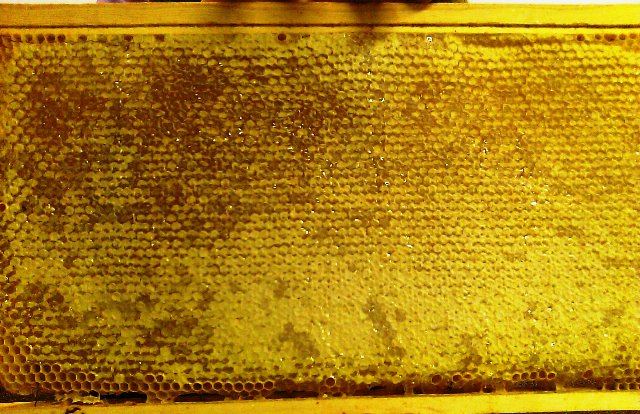
Picture 1: Fully capped honey frame ready for bees to eat or to be extruded

We also need to have a healthy set of brood to carry the hive on. Remember, a summer honey bee lives only for about 27 to 30 days. So, the queen must lay eggs often in order to have a steady supply of honey bees to come along throughout the summer season to keep the hive viable.
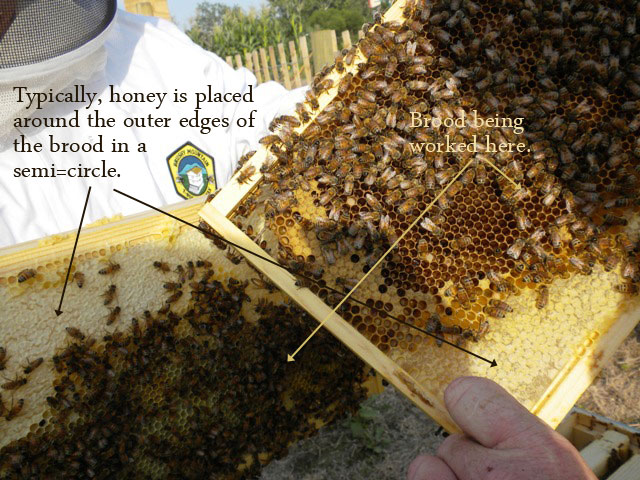
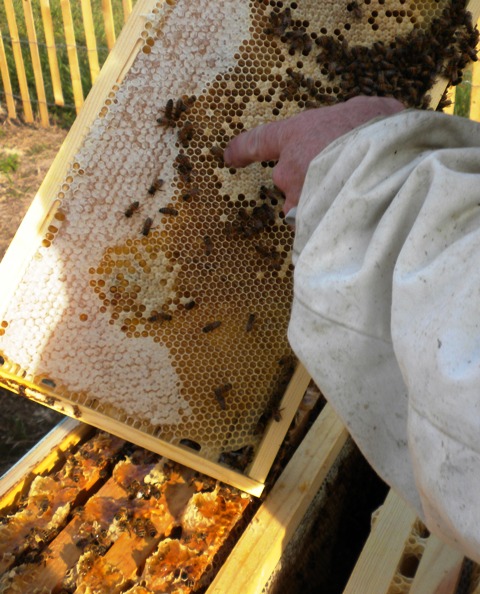
Picture 2: Two frames showing honey being placed around the brood section of the frame

When bees begin to work a frame, they initially build out the honey comb (See Picture 3 of “new” frame in early stages being worked). After the honey comb is developed, the bees begin to work part of the hive for storing honey to feed the brood as the babes begin to emerge and the queen will lay the brood in an arching pattern on the lower two-thirds of the frame. (See Picture 2 for examples).
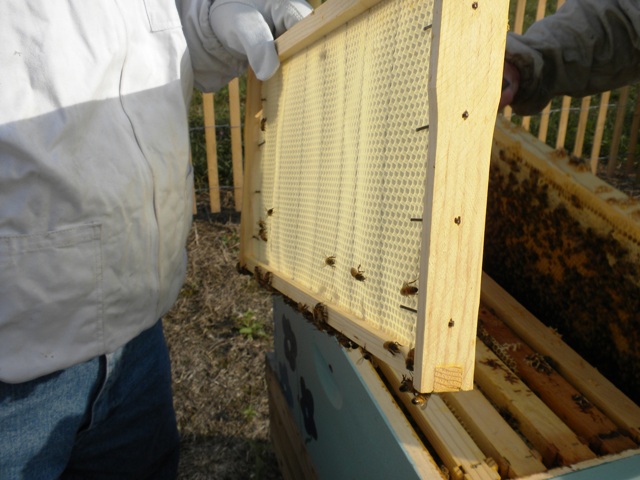
Picture 3: New frame beginning to be worked by bees.

 The foundation will be “extruded” by the honey bees into a hexagonal comb.

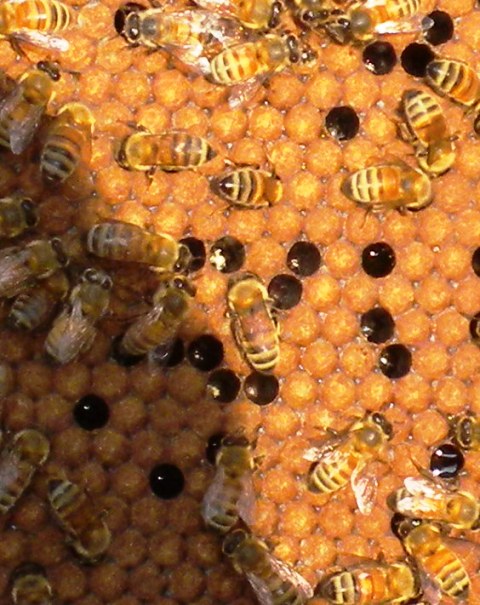
After adapting to opening the hives and learning to check them, you can see the difference between the honey and the brood. Picture 4 shows the bees capping the honey for storage. The white caps are what will be eaten away when the bees begin to delve into their stores during winter. While in Picture 5, the capped cells are brood cells. If you look closely, you can even see where some larva are starting to emerge as “new” bees.
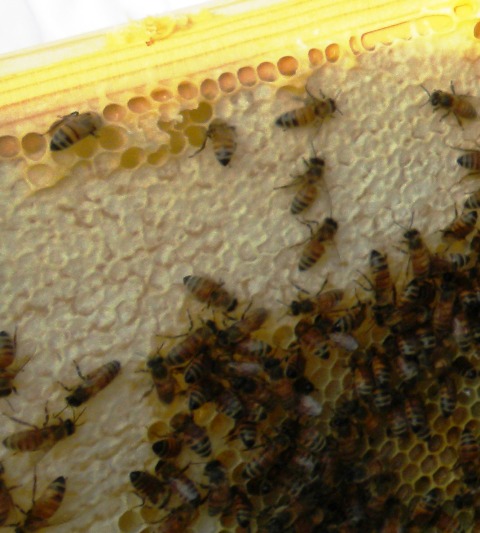
Picture 4: Honey being capped Picture 5: Brood and new bees emerging

The bees work so hard to prepare each cell and to manage the honey stores as well as tend to the emerging bees. There are two distinct groups of bees that conduct these chores. The worker bees are those who tend to the honey, while the nursery bees tend the brood. In Picture 6, you can see them working and almost can see their different efforts.
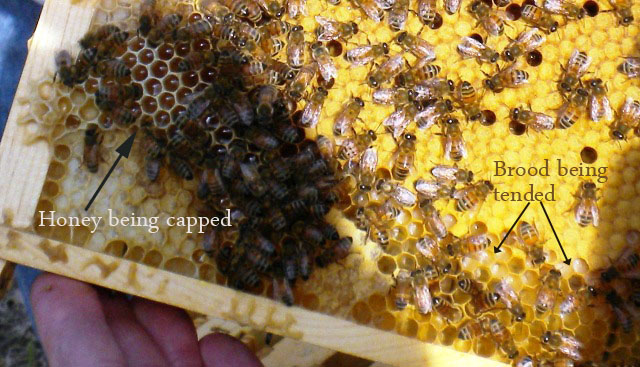
Picture 6: One frame showing two different groups of bees working. Notice the honey cells full of honey prior to being capped.

The queen is typically marked with a dot of color on her back to make it easy to spot here when checking hives. This is generally done with a marking pen in the beginning of the season or when a new queen is placed into the hive. The queen shown in Picture 7 is working at laying a brood while the bees around her are tending to the brood cells as well as tending to her. Generally, a cluster of bees are assigned to tend the queen by feeding, grooming, and general protection of her as she goes about her work.
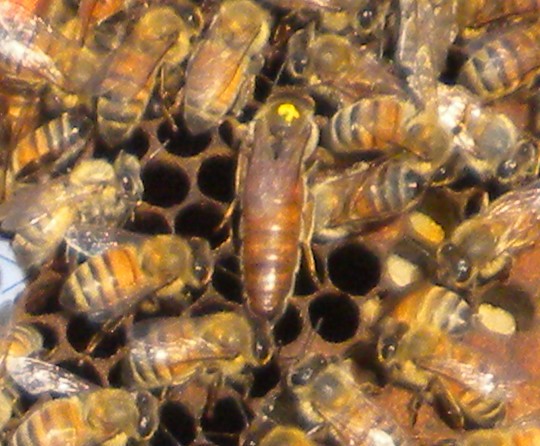
Picture 7: Queen with yellow marker on her back Picture 8: The Queen is slowly filling in the brood chamber area of a hive.

Notice the honey capped above and the comb worked out of the foundation down near the bottom edge

Picture 8 shows a frame where the honey has been placed and position to allow for the brood to be laid by the queen and worked by the nursery bees. If you look to the far right of the picture, you can see the brood section slowly being worked across the frame. Notice how the comb has been built on the foundation. You can see the hexagonal pattern the bees formed when they first built out the comb from the foundation.

So far, the hardest part of learning about being a honey bee keeper is keeping my hands out of the hives and leaving the lovely ladies alone to do their thing. They are so fascinating to watch and I find each time we check the hives that I just want to sit and watch them.

Now that it is winter, we don’t go into the hives unless it is a warm day, and then we are very quick to get in and out. We hope the day will warm enough this weekend that we can provide the ladies with some sweet syrup support.

Honey Cheers To You and Yours!
Hobbit Queen

Posted by: Pam B. Newberry | December 7, 2011

Pearl Harbor Day…We Remember…

It happened 70 years ago, the attack on Pearl Harbor. Twelve years before I was born, but my parents and my parents’ parents never forgot and they instilled in me the knowledge to not forget as well.

I wasn’t there when it happened, I wasn’t on this planet when America’s soul was rocked by the tragedy. But, I was here on September 11, 2001. That is solidly engrained in my memory along with the assassination of President Kennedy, landing on the moon, the explosion of the Challenger, and a few other personal episodes.

The life and death of too many souls is part of the life and death cycle of the great plan. Though I’ve learned about the life of Christ, the meaning of Christmas, and hold the belief that there is a greater power, I find myself questioning all my beliefs when someone close to me passes on.

Remembering Pearl Harbor is one of those moments when I stop and reflect what kind of difference am I making in the world and I think of those who’ve touched my life and are no longer with me this day. One such lady, was a colleague, friend, mentor, and the ultimate school teacher. She left us here on Earth many years ago, but while she was here she definitely made her mark. She left me with the strong need to always remember Pearl Harbor and the sacrifice of others. She did it very quietly. She wore a Pearl Harbor pin. A quiet statement that spoke volumes. I don’t have a pin to wear, but I do have a “pen” to make a quiet statement.

Those who died during Pearl Harbor, those who died in the battles to bring justice after the Pearl Harbor strikes, and those who have since died in the varied wars, I salute them and praise them for the dedication and service to our country. In the same way, I salute and praise for the safe return of those now serving our country in harm’s way. They do what no one else is willing or are able to do. THANK YOU!

Now, you’re asking, what does this have to do with honey bees? Well, directly, not much. You can, however, find a parallel connection if you look.

This time of year is hard for the honey bee. The changing weather, drops in temperature, and the uncertainty of each hour, let alone the next day are all part of a honey bee’s life and death cycle during the winter months.

The other day, the weather was not quite up to 55 degrees F. Bees die when the temperature drops below 55 when they wonder out of the warmth of the hive. To my surprise, while looking over the hives, I noticed a little bee come out of one the hives and she suddenly stopped and died. I felt my heart cringe. Here was a bee that was either leaving the hive because she was old or she was a young bee heading out and fell prey to the cold. I wondered why would the bee come out of the hive to die if it could have stayed in the warm to survive.

I watched a nearby hive and saw several more bees emerge and two fly off. I wondered if they would be coming back or also die in the cold. And then it occurred to me. They were scouts. It is their job to sacrifice and to determine if they can forge for food. Honey bees use a tremendous amount of energy (food stores) to keep the hive at a constant 92 degrees F to protect their brood (the young). They must replenish those stores or starve. Starvation is the number one killer of honey bees in the winter.

As I stood there I recognized the parallels between our dedicated servicemen and women and their need to protect us and our way of life with that of the honey bee. I saw the valor in those honey bee scouts. I saw the connections and the cycle of life. I abhor war. I have a great distaste for those who want to covet what we have and are not willing to work hard for their own rewards and support what we have built over the two hundred thirty-five or so years of this countries existence.

Its been said by many that if we don’t know our history, we are doomed to repeat it. Honey bees protect themselves from failures learned by passing on knowledge through their gene pool, use of hormones, and educating their young through dance. The more I learn about the honey bee, the more I realize how much we should work at protecting them, studying them, and passing on what we learn from them.

Our challenge this winter is to make it through with all four hives intact. Statistics tells us that we should be happy if we make it through with 50% of our hives. I’m hoping we beat the odds.

We have spent the past five months working hard to help prepare our ladies for the harsh time of winter.  We treated them against the horrible varroa mite and other ravaging diseases. We helped them build their stores of food to the recommended 60  lbs. of honey in their frames. One way we did this was by choosing not to rob them this first year in order that they would have enough to make it through the winter. We will provide them with supplemental food when the weather allows. We placed a wind break around the hives to reduce the strong winds that blow through the bottom land. And, we will watch them through the winter months and pray they are able to survive in spite of all the various dangers that lurk in their environment, such as  bears.


Beehives ready for winter

During this glorious Christmas season, I am thankful for Hobbit King, his wisdom to encourage us to take up the hobby of beekeeping, and the courage to include me in that endeavor. I’m also indebted to you, my reader. I hope this little blog has been helpful at sharing with you the value of the honey bee and how you, too, can make a difference by doing the little things that will help keep our environment and the world a little safer and healthier.

May you and yours have a blessed Christmas and a glorious Happy New Year!

Always with Honey Cheers,
Hobbit Queen

Posted by: Pam B. Newberry | November 29, 2011

Time Flies….

The last blog I posted on May 15 of this year, in some respects seems like yesterday, and in others, it seems like a lifetime ago.

Just where does time go?

How do I begin to catch you up on all of the happenings of honey bee life here on Hobbit’s Bend?

When we received our bees, it was wonderful to see them become acclimated to their new homes. Four hives! Four hives with 20,000 to 30,000 bees each, and each with a lovely queen.

Beehives with Bee Nucs - Waiting

Notice the bee nucs sitting on top of each hive. This is to let the little ladies get used to the idea of their new environment.

Aligning beehive frames using spacers

In this hive, the four “nuc” frames have been removed from the nuc box and placed into the hive. Next, the frames are spaced using special spacers to align the frames, which allows the honey bees to have the correct amount of space to continue to build and fill out each frame in the hive.

The nuc box is placed at the entrance to the hive in order to allow the lingering bees to move into the hive. The bees follow the scents and smells of their fellow bees and cluster at the entrance.

Nuc Box placed at entrance of bee hive

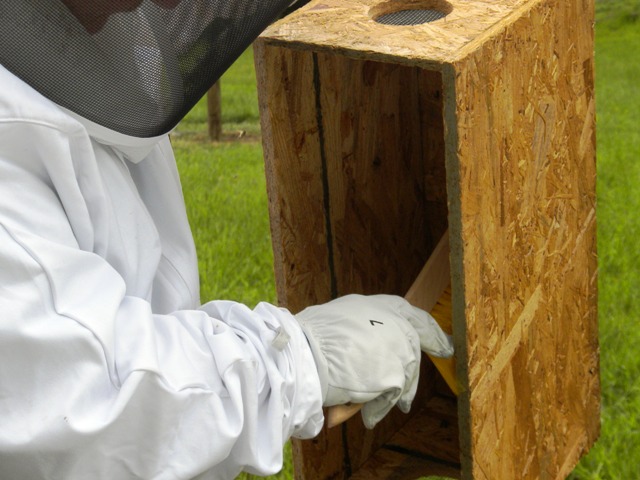
Below, you see Hobbit King brushing the bees into their new hive. After you place the four frames from the nuc into the hive, the brushing helps those lingering bees leave  the box.

Brushing lingering bees from nuc box into hive

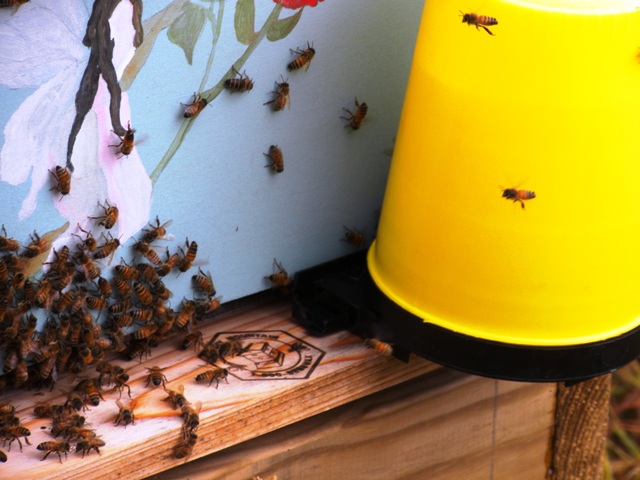
Here you see the little ladies moving into their new home. Notice how they are clustering around the opening. They are also checking each other out, touching antennae, and brushing up against one another.

Honey Bees checking out their new crib

In this picture, you will notice bees are clustered around a small box with a screen on it. This is how the bees get to know their queen. When a  queen is placed in the hive, she is generally in a small box with a screen. On one end of the box is a hole covered with a piece of sugar candy. The bees eat away at the candy and in doing so, it helps the bees get acquainted with the queen and her hormones. This way the bees bond and become one unit. When the candy is eaten through, the queen moves out of the little box and into the hive and begins her daily work of laying the brood

New Queen Introduction to a bee hive

After repeating the above process three more times, we then placed the yellow syrup feeders on each hive in order to provide the bees with a little shot of food until they have time to learn where the flowers, pollen, and nectar are located within their foraging areas.

Hives at the ready - Honey Bees new homes at Hobbit's Bend

Each hive has a yellow sugar syrup container,  four frames of honey bees (~about 20,000 to 30,000), and a queen.

We now sit back to see how it goes…

I hope you find this information helpful and you are able to learn more about the lovely honey bee and all of her habits.

In my next post, I’ll share various encounters we had during the summer, along with the trials, tribulations, and a few challenges. Learning to be a honey beekeeper has taught me one very valuable lesson – Patience! I’m learning to let go of my “Type A” way of life. I’m learning to be more relaxed, thoughtful, and strive to live a  purposeful  life. These last six months, I have come to cherish my time with the honey bees and have enjoyed each encounter with awe and wonder.  It is hoped that the reading of this blog brings some of that experience to life for you.

Honey Cheers to You and Yours,

Hobbit Queen

PS: Please remember to vote and let me know what you think…Here’s to blogging again!

« Newer Posts - Older Posts »

Categories