Where does a love come from? How does it evolve? For some it seems to come with a blink of an eye or as you’ve heard, “At first sight…” For others, it takes a knock on the head before you even recognize that something is happening between you and the guy lying next to you.
In my life, I tend to fall into the later category. I get so involved in daily life that I don’t even realize how much I come to depend on someone. I fell head over hills in love with Hobbit King almost 34 years ago. Imagine, I really had no idea until he told me one lovely spring day in 1977 that I loved him. You see, I thought I was in love with his best friend. Was I ever wrong! Hobbit King and I married a year later and have been best friends and lovers ever since!
In a similar way, I tend to love or depend on animals and inanimate objects with different degrees of intensity. Our daughter’s dog Myloh, we lovingly call Grand dog, is the light of our life. If he were human, I’m not sure I could love him any more. If he were to speak in English to me, I know I’d sit right down and carry on a conversation as though it was as normal as rain. Yeah, I do talk to him often. He sits and listens and paws and does his doggie sounds in a way I call talking. It’s as if he says, “Gees, Granny, I understand.”
And now, I find the same thing happening to me with our honey bees. The funniest part, we haven’t received them yet. All of the preparation and planning for them makes me feel as though I’ve known them for ever. I have no idea how I’ll feel when we actually get them, but I can tell you I love them already. It seems bee keepers have a strong affection for their bees, no matter how many or how long they keep them.
One of the early researchers of honey bees, Gregor Mendel (1822-1884), who is best known for his research of the garden pea, turned to studying and trying to produce superior stocks of bees. His failure was due to his lack of being able to control the mating behavior of honey bees.
Honey bee queens mate while in flight. The queen emerges from her cell as an adult and takes her first mating flight away from the hive about six to twelve days later. She may take several flights and mate with as many as twenty different drones. Each drone during mating can deposit as much as six to ten million spermatozoa into the queen’s oviducts and upon completion immediately dies. Those drones who do not mate by the end of the season are kicked out of the hive. The life of a drone gives a new meaning to being a gigolo.
After these matting flights, a queen never mates again, but is able to store about a third of the spermatozoa, which remain viable in her spermatheca throughout her egg-laying life. How many you wonder? How about six to ten million. A single queen lays all of the eggs that develop into workers, drones, and future queens.
Now a big question is how would anyone know this about the honey bee? Until E. Norman Gary decided to find out about honey bee mating behavior, no one did. Gary is best known for filming a honey bee queen tethered to a balloon and suspended in a drone congregating area. Through this work, he was able to discover and identify the queen honey bee’s sexual attractant pheromone. This information laid the ground work for later discoveries that enabled improved controlled mating of honey bees for the purposes of improving bee stock.
This raises another question, “Why do we humans feel we must improve on life?” There is a part of me that wishes we’d leave the world alone and let it be. But, we have already done so much damage that I understand the need to “improve” or better yet, “fix” the problems. The old technology adage, should we just because we can, should be a new battle cry for those of us who are learning how to “live and let it bee.”
Yet, I know that if anyone in my family, including Grand dog Myloh, needed special medical care requiring experimental treatments or the latest technology, I’d be the first to ask and agree for such help. At what price? The work that is being done to improve bee stock is important in order to learn more about colony collapse disorder, to learn how to raise bees in environments that are hostile, and to learn how to maintain the various stock of honey bees we currently have available.
The answers to the questions are not easy, no different from those asked each day in your life. Knowing that the trade-offs, consequences, and choices are made with eyes-wide-open is paramount to making good decisions in the life of honey bees as well as in the life you choose to live.
Hobbit’s Bend Farm Status of Bee Hive Prep:
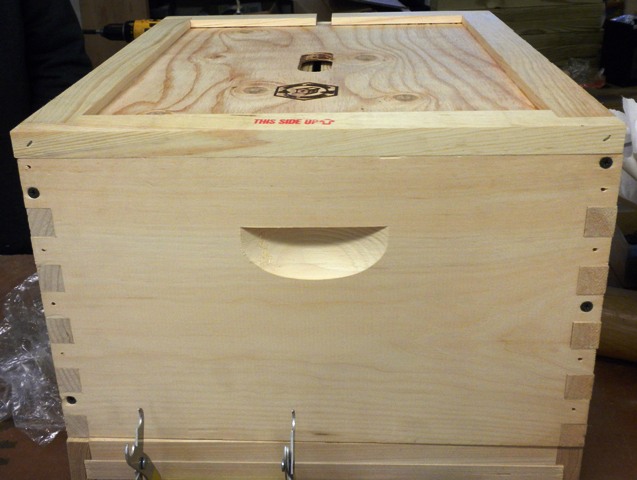
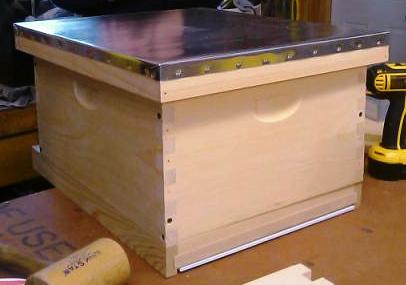
Hobbit King is on a roll. He has managed to put all of the parts for four hives together. And, he has built stands for the hives to sit when we place them in the bee yard.
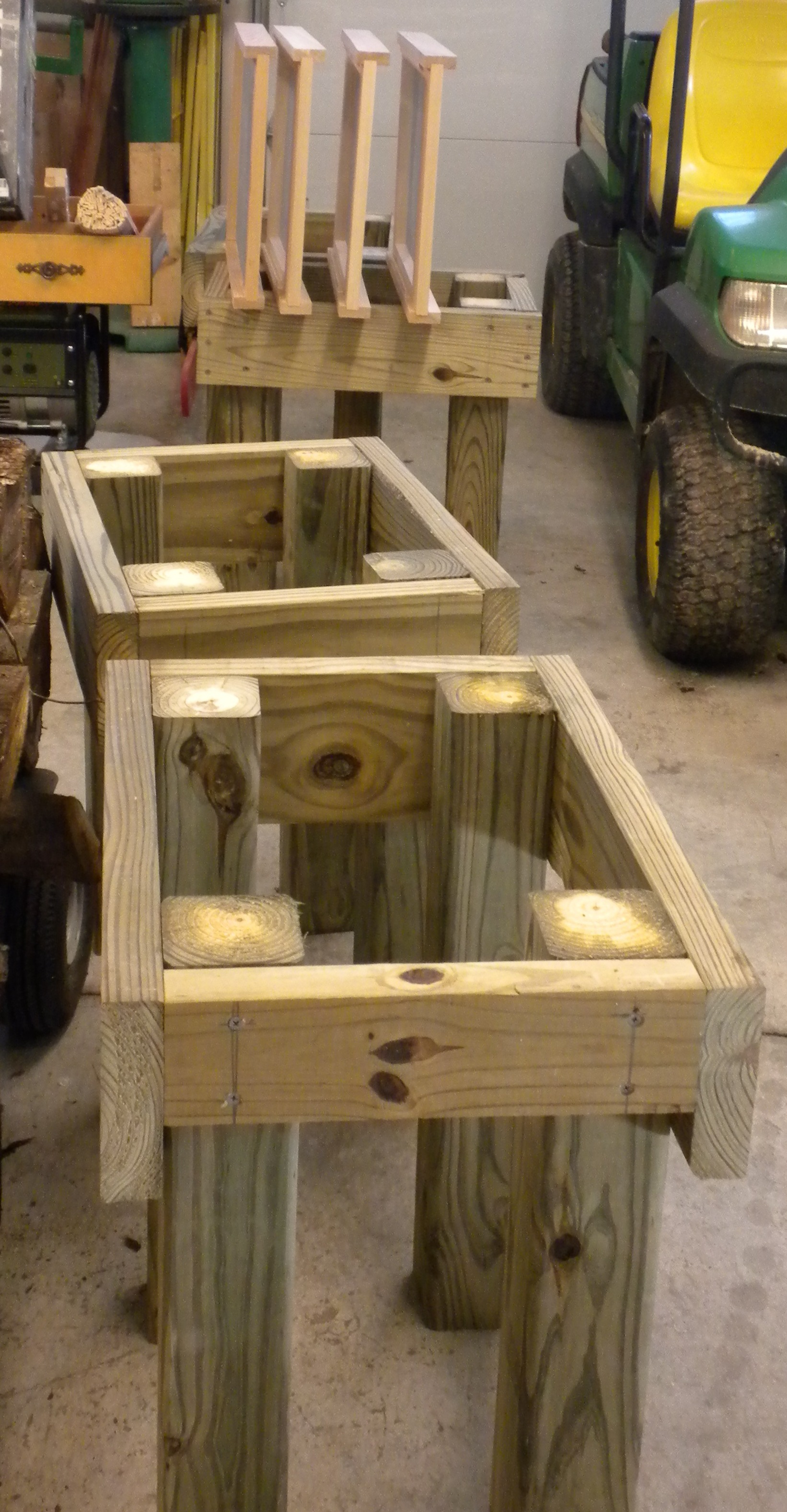
Bee Hive Stands at the ready.

Side view: Bee hive on bee stand
Today, he is painting them. The outsides of each box is a lovely green. In the picture, he is painting the first coat. We plan on adding a second coat and after the sides dry, I’m going to try my hand at adding some decorations. We have no idea what kind of swirls , but we’ll have fun planning the look.

Painting the Supers
I’ve read where some people have added large numbers or letters on the top cover; sort of like an airplane landing strip kind of look. There is no research that says it helps the bees find their way to their particular hive, but it sure helps the beekeeper think he or she is helping the bees find their way home. Who knows for sure, but we may just give it a try. If nothing else, it will look interesting.
At this time of celebrating love of all kinds, have a glorious Happy Valentine’s Day! May you have love in your heart, in your life, and in your world, always!
Honey Cheers with Honey Love,
Hobbit Queen





 Miss Beehaven with Hobbit Queen