Posted by: Pam B. Newberry | March 6, 2011

Unexpected Events…

The Surprise of a Friend

On Wednesday of this past week, a girlfriend (who happens to have recently started her own blog at http://twistsofatale.blogspot.com/ )surprised me with an early birthday gift. And what a surprise it  was indeed! She took me to see Celtic Woman in concert in a nearby town. The beauty of the surprise was that I didn’t even know I’d be going anywhere with her. She had conspired with Hobbit King to plot the trick. He had told me to hold the date and to plan to go somewhere. And, now that I think of it, he never really said to plan to go somewhere with him. I need to be careful how I listen. 🙂 

A honey bee must learn how to listen and pay attention to its fellow worker bees. Especially those who forage and bring back the first pollen of the season. When she comes in to tell the other bees where to find the pollen or nectar, she performs a dance to communicate. It is a fascinating dance of communication that changes depending up on the distance of the food.

Bees will travel up to six miles in any one direction in order to gather needed stores to make the honey and bee bread the bees need. Bee bread is a mixture of pollen and some nectar to form a mixture  that is protein-rich food used to feed the young brood called larvae.

Because of all of the hair  on a bee’s body, she is able to gather lots of pollen. She skillfully moves the pollen to the pollen sacs (See Pollen dances on my knee – I’m so happy to be a bee blog for how this is done), in order to fly back to the hive with this important food store. 

Flowers that attract bees and other insects, birds, and mammals do so through a sweet fluid produced by flowers called nectar. Forging bees drink the nectar and store it in a pouch-like structure called the honey sac. When a forager first locates blossoms with nectar and honey, she flies back to the hive and communicates with that dance I mentioned earlier to the other  forging bees just where they must go in order to find the flowers.

Research has shown that bees communicate in multiple ways. A major form of communication by way of pheromones, helps bees know when to be alarmed or other repellent scents, when the Queen is around, when she is sexually active, or when the hive is ready to swarm. This was revealed in the 1960s and 1970s when special equipment was designed to help researchers learn about the modes of communication. The most fascinating form to me, however, was the bee’s dance, which was first learned about in 1944 by Professor Karl von Frisch. He found he could “read” the dance language of the honey bee. Can you imagine how excited he must have been when he first realized what he was watching. And, researchers have since learned that sound is associated through the dance as well. Gives a new meaning to the sound of the “Bee Gees,” doesn’t it. 🙂

The chief dance is the waggle dance. This dance conveys to the nest mates the distance and direction of the food source from the hive. The scout forager will not perform this dance just because she found a food source and her enthusiasm of the dance helps convey how far or close the food is to the hive. She will do the dance as soon as she returns only if it is a rich source and to let her fellow foragers know they need to get to the food quickly. Otherwise, she may go to the site more than once to make sure the food source is worth sending her fellow foragers to gather the nectar and pollen.

The steps of the waggle dance are based on several factors. The waggle dance move that goes straight up the hive always means to the bee to fly in the current direction of the sun, wherever it may be. Sometimes this may be dancing to the bottom of the hive, which moves go in the opposite directions of the sun. The length of the waggle plus the distance walking back to where the waggle began is the distance to the food. The speed of the dance also translates to the bees the distance of the food. A very slow dance means the food is very far away.

A second dance is the round dance. This dance is usually used for food that is less than 300 yards or so away. The steps are very simple with no waggle, and the bee just goes around and around. The bees know to smell the scent of the nectar or taste the pollen that is on the scout to acquire the scent to find the nearby food source. The interesting part, is the same dance that bees use to communicate where to find a food source is also used to tell bees where the next site for a new home may be found when a hive is reading to swarm.

The Joy of a Reunion

This weekend, dear friends of ours had a family reunion of sorts. Everyone – friends and family – they hold dear are invited to this annual gathering of  renewal of friendships, fellowships, and just good ole fun. The weekend begins with people gathering from all over the south-east on Friday evening with the sharing of soup, homemade and wonderfully warm for the soul. In fact, the entire weekend is one of eating, eating, and more eating. You might say we forage and gather as much food as we can and tell stories, laugh, and enjoy being together.

Saturday evening finds more family and friends coming together for an unforgettable meal that concludes with an exchange of gifts in a game formation that is just as fun and filled with lots of laughter as any fun house ride I’ve experienced. Sunday morning, we gather yet again for a breakfast cooked by the men that is a wonderful pampering.

Spring season for bees starts much earlier than for us. Their spring time is now, with the first blooms of the willows and maple trees from late January to mid-March. As they forage, they really pack in the food in about a three-week period. Often, this three weeks is the main gathering of pollen and nectar to make all the honey stores the hive needs for the rest of the year. Kind of like us at the reunion this past weekend. I know I ate enough food to last me several weeks, as the pounds now prove. 🙂

Hive Preparation Update

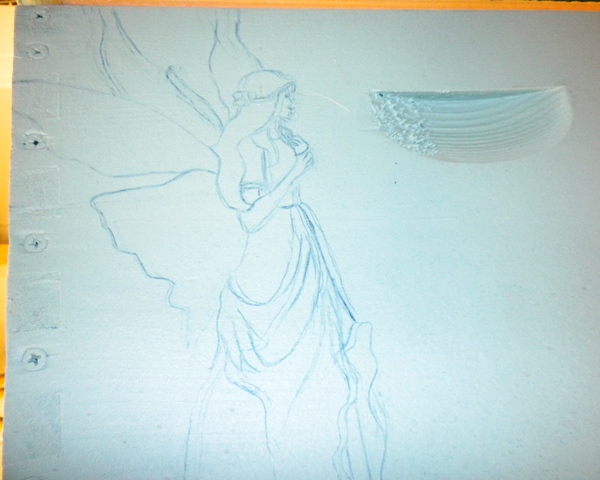
During this week, Hobbit King and I continued to prep the hives for their debut use in late April. I, along with Princess Daughter, began to sketch out the designs and paint them. Princess Daughter did the sketches while I began applying the paint. We’ve got a way to go, but so far the hives are starting to look like they’ll make a great home for our bees. What do you think?

Fairy Landing - sketched by Princess Daughter

Beehive sketch ready to be painted - 3-06-11

Sketch of Fairy walking – needs to be painted
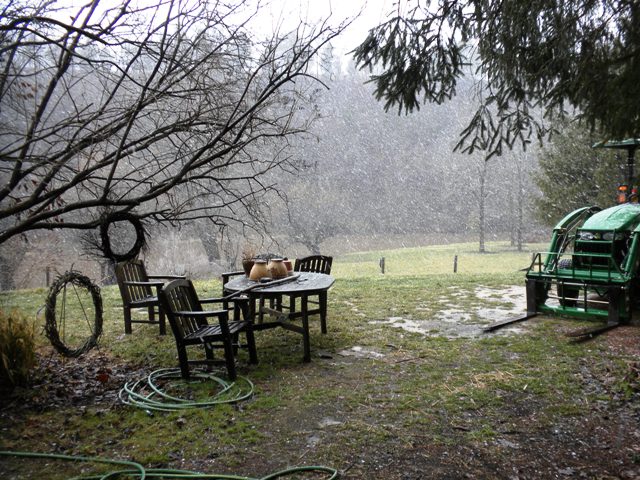
Continuing with unexpected events, we had an unexpected snow fall today. This scene is looking out our back door this morning prior to the flood. Yep, we had an unexpected flood too.

Unexpected Snow – 3-06-11

The creek that is flooded is normally about 25 feet wide. Here, you can see it is a great distance out of the banks. The pole you see in the center of one picture is about 10 feet from the bank under normal times. That pole is where we tie our boat. Our boat is a small, roof top boat, about 14 feet long, we lovingly call the Hobbit Queen. Yeah…you get the connection to the “African Queen.” 🙂

 

Pole 10 ft from bank – Flood 3-06-11

This is a view from our garden. The trees you see out in the middle of the water we normally can walk right up to on solid ground. Our whole bottom area is now under water. Luckily, the bee hives are up away from the water, at least they are as we prepare for bed tonight.

Garden at edge of flood - 3-06-11

As we begin another week, here’s to you having a week full of unexpected events and happy times full of food, fun, and laughter! Don’t forget to leave a comment, share your thoughts, and please vote if you like what you are reading. A vote each time helps me very much! Thanks for reading!!

Honey Cheers,
Hobbit Queen

Posted by: Pam B. Newberry | February 27, 2011

Buzz-wiser: Three Things I Learned This Week – Okay!

  1. Honey, Pure Food, and Drug Laws
  2. How Heavy Honey Can Be
  3. February & March Hive Duties


Honey, Pure Food, and Drug Laws

Sitting in our lounge chairs with a warm fire glowing in the fireplace, Hobbit King began to share a tidbit he was reading from the ABC Book1 of beekeeping regarding honey, pure food, and drug laws.

I was captivated to learn that honey is one of the most regulated foods. In 1880, in the United States, an effort was made to get a law on the books that would protect people from getting “fake” honey or un-pure honey. People were selling sugar water as honey.  It wasn’t until 1906 before the Drug Food Act was accepted and a law that states that honey must be pure and unadulterated. You’ll find many different variations of “real” honey out there. Raw honey is considered to be the most nutritious, while pasteurized honey (i.e., honey heated up to 145° F for at least 30 minutes to kill potential bacteria and reduce crystallization of the liquid) is the most common found in many grocery stores.

Today, if you take the time to read small packets of honey that are sometimes sold with fast foods, such as chicken, you’ll find the package ingredients leads with variations of sugar water. On the front of packages of food, the use of the words “honey flavored” is found. Yet, when you read the ingredient lists, there is very little “honey” in the food; again it is a variation of sugar water.

The honey bee spends its life making honey only to have someone or group of “some ones” come along and create a substitute (some would call fake) all in the name of money. I’ve often said that you get what you pay for. And, as I age, I find that adage is more and more true. I find I get disgusted with people who want to cut corners or avoid honest labor.

During class this week, we learned that honey bees have a division of labor within the honey bee colony and it is based on age. When bees first emerge, they spend the first two or three hours of life  cleaning out the cell from which they were born. Imagine, if as a baby, we were able to know the value and need of keeping our environment clean. I wonder how our world would be different.

The next job of the honey bee, beekeepers refer to as “Nurse Bees.” The Queen is busy laying eggs and that is all she does. She is fed, groomed, and kept by the Nurse Bees. I was amazed to learn that the Nurse Bees will even block the Queen bee from laying eggs to tell her it is time to take a break and eat. I’d love that kind of pampering. Hmmmm…I think I need to consider setting up such a deal up with Hobbit King. Do you think he’d consider it? 🙂

The Nurse Bees are young, worker bees of about 3 hours of age to about 10 days old. In addition to caring for the Queen, they feed the larva and take care of the brood chamber. As new bees emerge, the older Nurse bees move to the next job in their life cycle. These are the “House Bees.” They form the heart of the hive. Their duties are varied and the bee seems to know when to switch from one job to another as the hive requires. Reminds me of the Borg from Star Trek, “Freedom is irrelevant, self-determination is irrelevant, you must comply.” Some how hearing a machine-like voice say it is not the same has thinking that bees work as a collective.

Keeping in mind that during the summer, a bee’s life is about 30 days, the house bee works hard for about 10 to 20 days at doing household hive duties, such as comb building, keeping the hive clean, undertakers (moving out the dead), guarding the hive, and receiving and storing pollen, nectar, and making honey from the stores. These bees are also responsible for climate control of the hive.

Near the last days of a bee’s life (i.e., 20 days to 30 or 45 days), she becomes a forager. She goes out and gather’s pollen, nectar, and water, and brings the golden food back to the hive (See Pollen on my Knee – I’m so happy to be a bee blog that goes into more detail regarding this important work). To make one pound of honey, forager bees must visit 2,000,000 flowers, bring in 8 to 10 pounds of nectar, which results in flying over 55,000 miles. Amazing! Remember, the life work of one bee is equal to 1/12 teaspoon of honey. A small drop in the jar of honey you buy at the store.

As I said, a hard day’s work for a hard day’s pay. The honey bee is a good example of “paying it forward.”

1From The ABC & XYZ of Bee Culture, 41st edition, edited by Shimanuki, H., Flottum, K., & Harman, A. pg 444.

How Heavy Can Honey Be

This week in bee class I learned just how heavy a frame of honey can be.

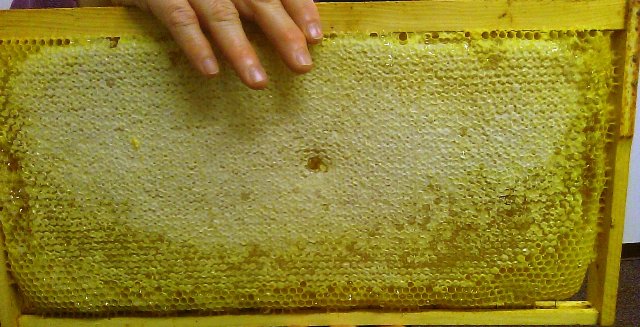
Frame of Capped Honey (Size: 17 3/4" x 9 1/4")

One of our MEBA member’s brought a honey comb from one of her hives to class to show us “newbees” what to expect when a hive is up and going.

Notice the size of the comb cells. Each comb cell has been tended to by a honey bee. The pollen, nectar, and water are turned into honey and it is inserted into the cell and capped. The capped cells store the honey and hold it in place. The bees are then able to get the their precious food during the cold winter months or when needed. This frame is 17 3/4″ x 9 1/4″ and when empty weighs approximately 3 to 4 oz. When fully laden (See the pictures above and below), it weights approximately 8 lbs.

Closeup of Frame with Capped Honey

 A typical hive will hold 10 frames this size.  That’s 80 lbs. or so of honey!!! Heavy indeed!

We’ve decided to use only 9 frames in each of our hives because of the weight. We will be using a smaller size “Super” frame (See info on a Super frame below). The reason is we are old and our backs don’t need to be lifting such weight. So, our frames from the Supers will weigh more along the lines of 40 or 50 lbs. per hive. This doesn’t seem like much difference, but when you have to lift 9 frames from four different hives, it can add up to a huge difference.

February and March Hive Duties

February has been a mixed bag of duties for us. We continued to build the hives and the many parts (See earlier posts – Hive Management 101) and we managed to get the hives painted. I hope to get my fingers going on putting some fancy touches on the outer hive bodies later today. Yeah, I know, I said I’d do it last week, but what can I say. Life got in the way.

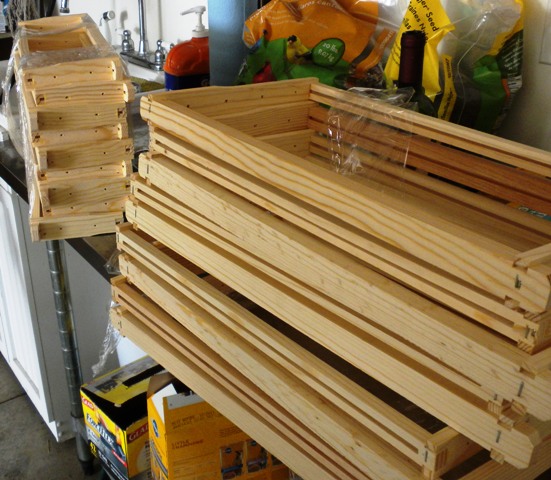
Hobbit King finalized putting the inner frames together. Here you see the frame for the Hive Body (See pic of a couple of stacks of different size frames below). This frame is the same size as the one shown above that is full of capped honey that we got to see up close and personal during our bee class.

Frame with Foundation in Hive Body

This frame (See above) in the hive body box has foundation comb inserted and held in place. The bees will come into he hive and will build on this foundation, which will eventually look like the capped honey comb frame above.

The next two pictures show a Super frame  (Size: 17 3/4″ x 5 3/8″) without foundation inserted that is being placed inside a Super of the hive. Remember the Super is where the bees will store their honey for their own use. We will have a Super that we will separate from the main body of the hive by using a divider (more on that later). This separated Super will be used for us to get “our” honey. This way, the bees will have their honey and we can have some, too, without messing in theirs.

Super frame (Size: 17 3/4" x 5 3/8") being placed into Super

Super Frame (no foundation) inside Super

Here’s a picture of a Frame Gripper tool that is used to help pull a frame out of a hive. I’ll share more on tools next time.

Frame Gripper tool being used to lift a frame


Stacks of two different sized frames ready for placement into the hives.

March will prove to be a very busy time for us. We’ve placed the hive stands (see pic) in our field and now we must prepare them for receiving the full hive bodies. Plans are for us to receive our nucs (Shorthand for nucleus honey bee colony, which is five frames or about 20,000 honey bees) in late April. We will receive four nucs from our Bee Mentor. Each nuc will have a queen, some brood started, and some honey comb.

Hive Stands placed in field waiting for the Bee Hives

As the weather warms, bees will be out foraging, building their brood, and beginning what is really their busiest time of the year. Today is proving to be a glorious day, so I’ll be out in the garden, prepping the soil, gathering debris, and cleaning my world…just like my bee friends! 

Here’s hoping your March will be as productive!

Honey Cheers,
Hobbit Queen

Posted by: Pam B. Newberry | February 20, 2011

Pollen dances on my knee – I’m so happy to be a bee

“Red sky in the morning, sailor take warning; red sky at night, sailor delight.”

After the winds of yesterday, to see this red sky this morning, I thought what could be coming our way now? 

Red Sky in the Morning -- February 20, 2011

We’ve been blessed with lovely weather these last few days. Even with the wind we’ve had you could still enjoy the sun beaming down. But, yesterday’s wind was just plain rough. The weather has been warm for this time of year, and I’m sure many bees were out and about doing their thing; forging to find what is in bloom. I know a friend of mine posted on his Facebook page that his bees were bringing in yellow pollen and he wondered what or where they got their bundles. Someone replied it may be some trees that are starting to bloom.

Tuesday this week, Hobbit King and I started a second bee class. Bernie, the instructor, shared his favorite picture of a honey bee laden with pollen. (This picture captured from the Mountain Empire Beekeepers Association’s website with permission is shown below.)

Honey bee foraging with pollen in pollen sac (basket)

Notice the nice large orange sac on the bee’s hind leg. Bernie explained the different purposes of the external anatomy of the honey bee — the head, thorax, and abdomen. He then spoke about each section with details about the parts of each. In particular, I found his explanation of what happens when a bee gather’s pollen to be very interesting. Bernie shared that as the bee gather’s pollen with her front legs, she moves it back to the hind leg, and the back leg acts like a “jack” to pack the pollen into the sac. After class, Hobbit King and I talked about this on our way home. Later, he found this excerpt from The ABC & XYZ of Bee Culture, 41st edition, edited by Shimanuki, H., Flottum, K., & Harman, A. pg 648 that goes into more detail explaining what happens:

During foraging, a bee’s body becomes dusted with pollen. Her tongue protrudes and regurgitates nectar that is whipped onto the forelegs, which then brushes the head, antenna, and front of the thorax free of pollen grains. Pollen on the back of the thorax is combed off by the middle legs and pollen on the abdomen is gathered by brushing movements of the hind legs. Eventually all the pollen is transferred to the hind legs. Here, a specialized rake, rakes the moistened pollen off the opposite leg onto the auricle of the metatarsus. This area, at the joint of the metatarsus and tibia, acts as a pollen press when the joint is bent squeezing the pasty mass of pollen up into the pollen sac (basket) where the pollen accumulates. The middle legs help mold, pack, and shape the pollen load into its characteristic kidney shape.

It’s a good explanation, but personally, I like Bernie’s. I can relate to the idea of a jack and how it must look if you were watching the bee move the pollen, up close and personal.

After hearing how a bee uses its hind legs for carrying the pollen back to the hive, I was intrigued to hear what happens next. Bernie shared that when the bee returns to the hive, the house bees will often watch nearby as the forager moves into to position and ready herself to empty her pollen sac into a waiting cell.

She will groom herself and dip her hind leg into a cell that may be empty or have pollen in it. She uses her middle legs to pry the pollen free and allow the pollen to drop into the cell. The forager will continue to groom herself to remove any remaining pollen that may still be in her pollen sac (basket). Once the forager believes she has groomed herself successfully, she’ll leave the cell for another bee (house bee) to push the pollen load into the base of the cell and pack it into place using her mandibles, face, and forelegs. After the forager deposits her load, she will solicit a third bee for honey, and then return to forage for more pollen or nectar.

As interesting as it is to listen as Bernie teaches, it is just as interesting to meet and greet beekeepers who are at various levels of experience. The room was full, about 75 strong. We met people who are just starting to try their hand at keeping bees (newbies like Hobbit King and I). We met people who had kept bees before, got out of it for some reason, and now are trying it again. And, we met people who have been with it for over twenty years.

The experience in the room provided me with a since of security and awe. I marveled at how many people were interested and would come to a bee class and at the same time, I found myself asking why would someone want to come to a class if they’ve been keeping bees for so long? I realized that it was because a beekeeper is eager to learn and embraces learning to keep himself or herself informed of trends, changes, and the latest “new” methods of keeping bees. More importantly, I believe it is because beekeeping is a social hobby, just as the bees are social insects.

Our class continues on Tuesday, so I’m sure we’ll learn even more interesting facts about bees as we build friendships with our new “bee” buddies.

~    ~    ~    ~    ~

Update on Hive Building:

We decided to change the hive color.  After looking at the full hive in sunlight, we determine the color may be a little too dark. Since we are placing a second coat on the hive, we decide to lighten the color by adding some white. Here is a picture of the hives with the lighter, almost a sea foam green color. They are stacked in this manner for storage purposes for now.

Painted beehive parts – stacked for storage

What we hope to do next is add a little more design to the hives. I’m thinking about doing a vine design with maybe a butterfly, dragon fly, and a few lady bugs; something that will be a lite touch and give the hives some character.

We are also in the process of placing the bee hive stands in the garden area. We still need to finalize building the frames that will hold the comb foundation. As soon as we get those built, I’ll share pictures and talk more about this important part of the bee hive.

Here’s hoping you have a glorious week and that the weather proves to be good for you and yours!

Honey Cheers to You!
Hobbit Queen

« Newer Posts - Older Posts »

Categories